
TerraVeda Insights · Seeds, Ecology & Farm Economics
Seed Diversity and the Economics of Regenerative Farming
A regenerative farm must renew the living systems that sustain production — and provide a viable livelihood for the people who care for them.
When I think about a seed, I see more than the beginning of a crop. I see inherited traits, possibilities for future harvests, and a connection to the people who selected, grew and shared it. It is a useful starting point for a larger question: what are we trying to build when we develop a farm?
My view is that care for the land and a viable livelihood for the farmer belong in the same conversation. As a practicing farmer, and through my work with TerraVeda, this is the question I keep returning to:
How do we create farms that remain productive while strengthening the natural resources and livelihoods on which their future depends?
For me, this is where regenerative agriculture meets farm economics. My background in transformation, finance and programme governance has shaped how I approach this: a vision needs an implementation plan, a resource budget and a way to assess whether it is working. A healthy landscape and a viable farm business need to be planned together.
The value of diversity begins with keeping options open
Seed diversity matters because different varieties offer different combinations of characteristics. Maturity, taste, storage quality and responses to local conditions can all influence a farmer’s choice. Conserving that diversity preserves options for both cultivation and consumption.
Navdanya’s community seed-bank work offers one example of conservation linked to farmers’ participation. The organisation describes seed banks managed by farming communities and the conservation and cultivation of traditional crops and varieties.1 The broader principle is relevant well beyond any one movement: diversity remains useful when people can maintain it, understand it and put it to work.
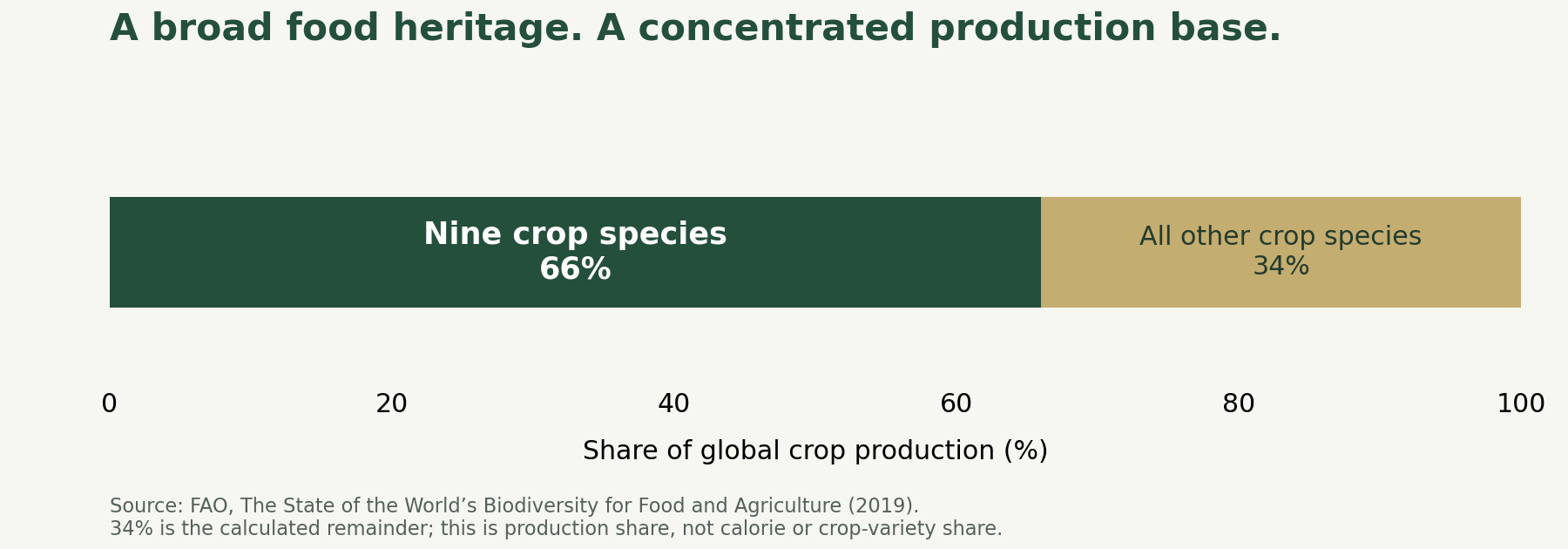
FAO’s 2019 global assessment reported that more than 6,000 plant species had been cultivated for food, yet just nine accounted for 66% of total crop production.2 This measures concentration at the species level; it does not mean that only nine seed varieties feed the world.
I see the first task as identifying which options are worth preserving and testing on a particular farm. A traditional variety may have culinary value but limited buyer awareness. Another may suit a particular season but require different harvest timing. Conservation and commercial cultivation can support each other when agronomic performance and demand are assessed together.
Diversity needs a purpose in the field
A diversified farm is more than a list of crops. Its components should perform useful functions: spreading harvest dates, interrupting pest cycles, supplying saleable products, or contributing residues that can be returned to the soil.
A major research synthesis by Tamburini and colleagues reviewed 98 meta-analyses and drew on 5,160 original studies. It found that agricultural diversification generally improved biodiversity and services including pollination, pest control, nutrient cycling and water regulation, without reducing crop yields overall. Outcomes nevertheless varied with context.3
I read this as a strong reason to investigate diversification, while recognising that not every mixture will succeed. Crops can compete for water and light. Additional enterprises can create labour bottlenecks. A crop with no dependable buyer may add biological diversity while weakening cash flow.
Consider a farm exploring a cereal–pulse rotation, a small vegetable block and planted boundaries. Before implementation, ask: Is water available at each crop’s critical stage? Will harvests overlap? Who will buy the produce, in what quantities, and at what payment interval? Which boundary species fit the local ecology without creating unwanted competition?
India’s ICAR has developed location-specific integrated farming systems combining enterprises such as crops, horticulture, livestock and fisheries with resource recycling.4 The useful lesson is to design around local resources and management capacity. Adding livestock, for example, creates daily requirements for feed, water, care and labour that the farm must be able to support.
Regeneration requires measurement, not just a change of inputs
Replacing one purchased product with another does not, by itself, demonstrate regeneration. The test I would apply is what changes in the field and in the farm accounts: soil condition, water use, crop performance, input dependence and net returns.
Organic certification, diversified farming and regenerative outcomes describe different things. Organic management has defined production requirements; diversification describes how a system is organised; regeneration needs to be evaluated through changes in its condition and performance. Evidence about one should not automatically be treated as proof of another.
For example, a 2015 meta-analysis by Ponisio and colleagues found organic yields averaged 19.2% below conventional yields across its dataset. In comparisons where multi-cropping or crop rotations were used only in the organic systems, the estimated gaps were smaller.5
| Comparison in the study | Estimated gap |
|---|---|
| Overall dataset | 19.2% ± 3.7 percentage points |
| Multi-cropping used only in organic systems | 9% ± 4 percentage points |
| Crop rotations used only in organic systems | 8% ± 5 percentage points |
Source: Ponisio et al. (2015), 115 studies and 1,071 comparisons. Uncertainty summarises reported 95% credible intervals. These are different groups within a global synthesis, not stages in one farm’s transition, not profit estimates, and not forecasts for Indian farms.
The practical response is to assess nutrient requirements, available nutrient sources and pest pressures before reducing inputs. Soil testing, crop observation and locally appropriate agronomic advice should inform the transition. Abrupt withdrawal without a workable replacement strategy can put the harvest and household income at risk.
A viable transition must survive the cash-flow test
A farmer pays bills with money received, not with the promise of a healthier system several years from now. Transition planning therefore needs a budget, a realistic sales route and enough working capital for setbacks.
Research provides examples of compatible ecological and economic gains. In an Iowa field experiment from 2003 to 2011, Davis and colleagues found that more diverse rotations maintained or exceeded several production and profit measures while using lower synthetic nitrogen fertiliser and herbicide inputs.6 This was a specific US farming context; its financial results should not be transferred directly to an Indian smallholding.
A simple example shows why both costs and revenue matter:
| Item | Existing system | Transition scenario |
|---|---|---|
| Sales revenue | ₹1,00,000 | ₹90,000 |
| Variable operating costs | ₹65,000 | ₹50,000 |
| Gross margin | ₹35,000 | ₹40,000 |
Hypothetical arithmetic only — not TerraVeda field results or an income forecast. Gross margin equals sales minus variable operating costs. It excludes fixed overheads, capital costs, financing and any family labour not included in the operating budget.
Here, lower costs more than offset lower revenue. But if sales in the transition scenario fall to ₹80,000, its gross margin falls to ₹30,000. The apparent advantage disappears. Additional family labour could change the comparison again.
This is why I believe a plan should test weaker prices, lower yields and higher labour costs before committing the entire farm. A manageable trial area, a comparison with current practice and records across relevant crop cycles can turn aspiration into a decision grounded in local results.
Respect for farmers must reach the transaction
I believe our respect for farmers should be visible in how we buy food. It becomes tangible through reliable purchasing, clear quality expectations, prompt payment and an understanding of what reaches the producer.
A high retail price does not automatically mean a fair farmer return. Sorting, spoilage, transport, packaging and selling costs all affect the amount retained. Direct marketing can help in some circumstances, but it also transfers responsibilities to the farmer or collective.
For a farmer group, aggregation, shared logistics or basic processing may be worth evaluating. Each requires a commercial test: sufficient volume, agreed standards, accountable management and buyers who will pay. Food affordability also matters. A durable model should improve producer returns while making distribution more efficient and keeping nutritious food accessible.
Bring local knowledge into the measurement process
I place considerable value on knowledge acquired through sustained attention to a landscape. Farmers may notice which patch holds moisture, which crop performs in a difficult season, or when familiar pest patterns change. These observations are valuable starting points for investigation.
The scorecard I would use brings those observations alongside repeatable measurements:
| Dimension | What to record | Decision it informs |
|---|---|---|
| Soil | Soil cover; comparable soil tests, including organic carbon at consistent depth and season | Whether soil-management changes are producing a measurable response |
| Water | Irrigation volume where metered, rainfall, infiltration observations and waterlogging | Whether crop choices and irrigation fit actual availability |
| Diversity | Crop species, varieties, rotation sequence, beneficial organisms and pest incidence | Whether added diversity is performing useful functions |
| Economics | Saleable yield, realised price, losses, input costs and labour hours | Whether margins improve after accounting for work and wastage |
| Livelihood | Cash-flow gaps, payment delays and household labour demand | Whether the system is manageable for the people operating it |
Record the baseline first, use consistent methods and interpret results alongside weather and market conditions. A single good harvest cannot establish resilience, and a single difficult season does not explain the whole system.
From a seed to a regenerative farm economy
For me, regeneration carries a responsibility to leave the farm better able to sustain life and livelihoods. That responsibility becomes practical when we preserve useful diversity, care for the resources that support production, and build an economic model that makes continued care possible.
A seed becomes part of a viable farm economy when it connects with suitable land, water, knowledge, labour and a market that values the harvest. The work lies in making those connections practical.
That is the transition I want TerraVeda to support: from regenerative agriculture to regenerative farm economies.
Planning a farm or reconsidering an existing system? TerraVeda helps landowners, farmers and institutions connect soil and water planning, crop diversity, implementation and farm economics. Explore TerraVeda.
Sources and further reading
- Navdanya. Community Seed Bank. Organisational account of its conservation work.
- FAO (2019). The State of the World’s Biodiversity for Food and Agriculture.
- Tamburini, G. et al. (2020). Agricultural diversification promotes multiple ecosystem services without compromising yield. Science Advances, 6, eaba1715.
- ICAR. Annual Report 2023–24, climate-resilient agriculture and integrated farming systems.
- Ponisio, L.C. et al. (2015). Diversification practices reduce organic to conventional yield gap. Proceedings of the Royal Society B, 282, 20141396.
- Davis, A.S. et al. (2012). Increasing Cropping System Diversity Balances Productivity, Profitability and Environmental Health. PLOS ONE, 7(10), e47149.
About TerraVeda
TerraVeda is a regenerative farm advisory and design practice focused on connecting land restoration with farm economics. Its work spans farm design, soil and water systems, implementation planning, farm economics, post-harvest value addition and farmer collectives.
From Regenerative Agriculture to Regenerative Farm Economies.
This insight paper reflects the author’s research, field learning and synthesis from interactions across the farming, startup and investment ecosystems. It is intended as a practical perspective rather than an academic or policy paper.
TerraVeda Insights
Receive new perspectives when they are published
Occasional writing on farm systems, economics, and the land. Unsubscribe at any time.
Form not loading? Open the signup page directly.
TerraVeda
Ready to put seed diversity to work on your farm?
TerraVeda works with farmers, landowners and institutions to connect crop diversity, soil and water planning, implementation and farm economics into one workable system.